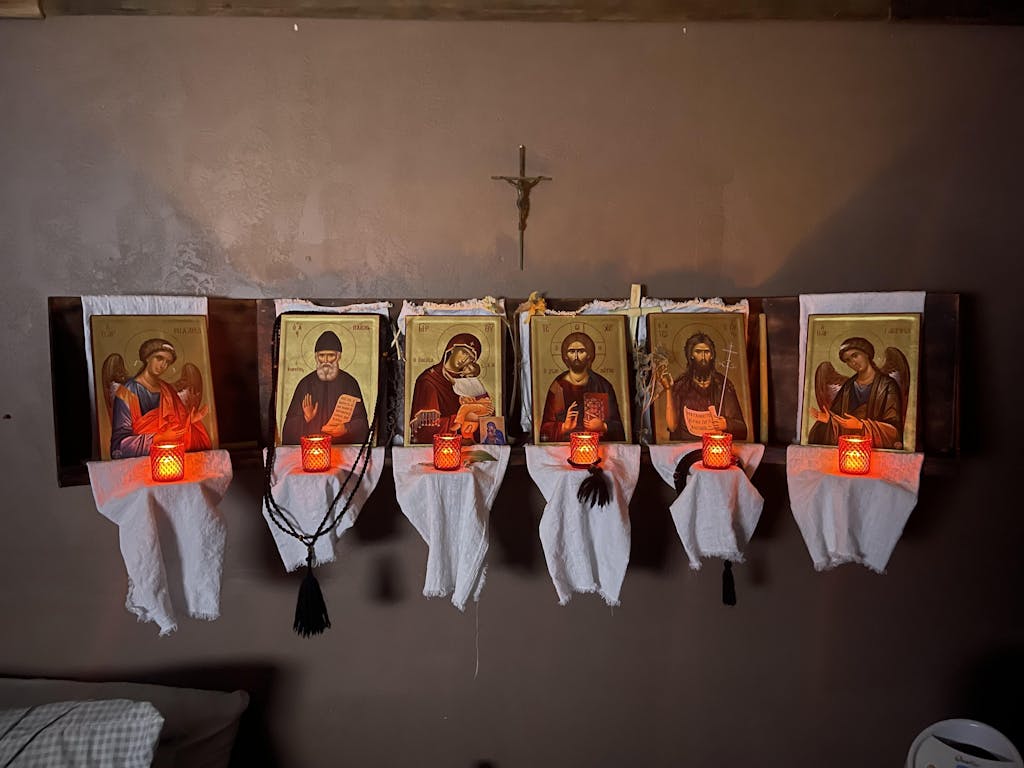
The Story Behind This Icon:
The Church commemorates Saint John the Baptist each year on January 7th.
Saint John the Baptist was the last prophet of the Old Testament and has become one of the most revered saints in the Orthodox Church. He was a preacher from a young age and proclaimed that baptism was for the forgiveness of sins. For this reason, he is also called Saint John the Forerunner as he declared that "another will come after him Who will not baptize with water but with the Holy Spirit". Although the Lord Himself had no need of the remission of sins, He nevertheless came to John "to be baptized by him and to fulfill all righteousness" (Math. 3, 13-15).
Saint John had a martyric end: following the Baptism of Jesus Christ, he was imprisoned by Herod Antipas, the governor of Galilee whom he had openly denounced for having left his lawful wife for the wife of his brother Philip, Herodias. On Herod's birthday feast, Herodias' daughter Salome, danced with Herod who, in turn, promised to give her whatever she asked for. After consulting with her wicked mother, Salome asked to be given the head of John the Baptist on a plate. Herod gave the order to cut off the head of John and give it to Salome.
Joanna, the pious wife of Herod buried the head of John the Baptist on the Mount of Olives. The body of John the Baptist was taken that night by the disciples of Jesus Christ who buried it at Sebastia.
Apolytikion of Synaxis of John theBaptist:
The memory of the just is celebrated with hymns of praise, but the Lord's testimony is sufficient for thee, O Forerunner; for thou hast proved to be truly even more venerable than the Prophets, since thou was granted to baptize in the running waters Him Whom they proclaimed. Wherefore, having contested for the truth, thou didst rejoice to announce the good tidings even to those in Hades: that God hath appeared in the flesh, taking away the sin of the world and granting us great mercy.
***
This icon of Saint John the Baptist is reproduced, with permission, from the authentic icon painted by the monks in the Cell of St. John the Theologian Holy Monastery of Koutloumousiou in Mount Athos, Greece. This icon is part of our collection "Icons from Mount Athos", which features all icons from the Cell of St. John the Theologian.
This icon is made of solid, natural limewood (Tilia) that has been prepared by hand using traditional methods and organic materials. The background is comprised of 22 Karat gold leaves that were meticulously applied by hand, piece by piece.
All of our icons are reproduced according to museum print standards and are authentic replicas of Holy Icons from Mount Athos and elsewhere.
Learn more about how our Holy Icons are made here.