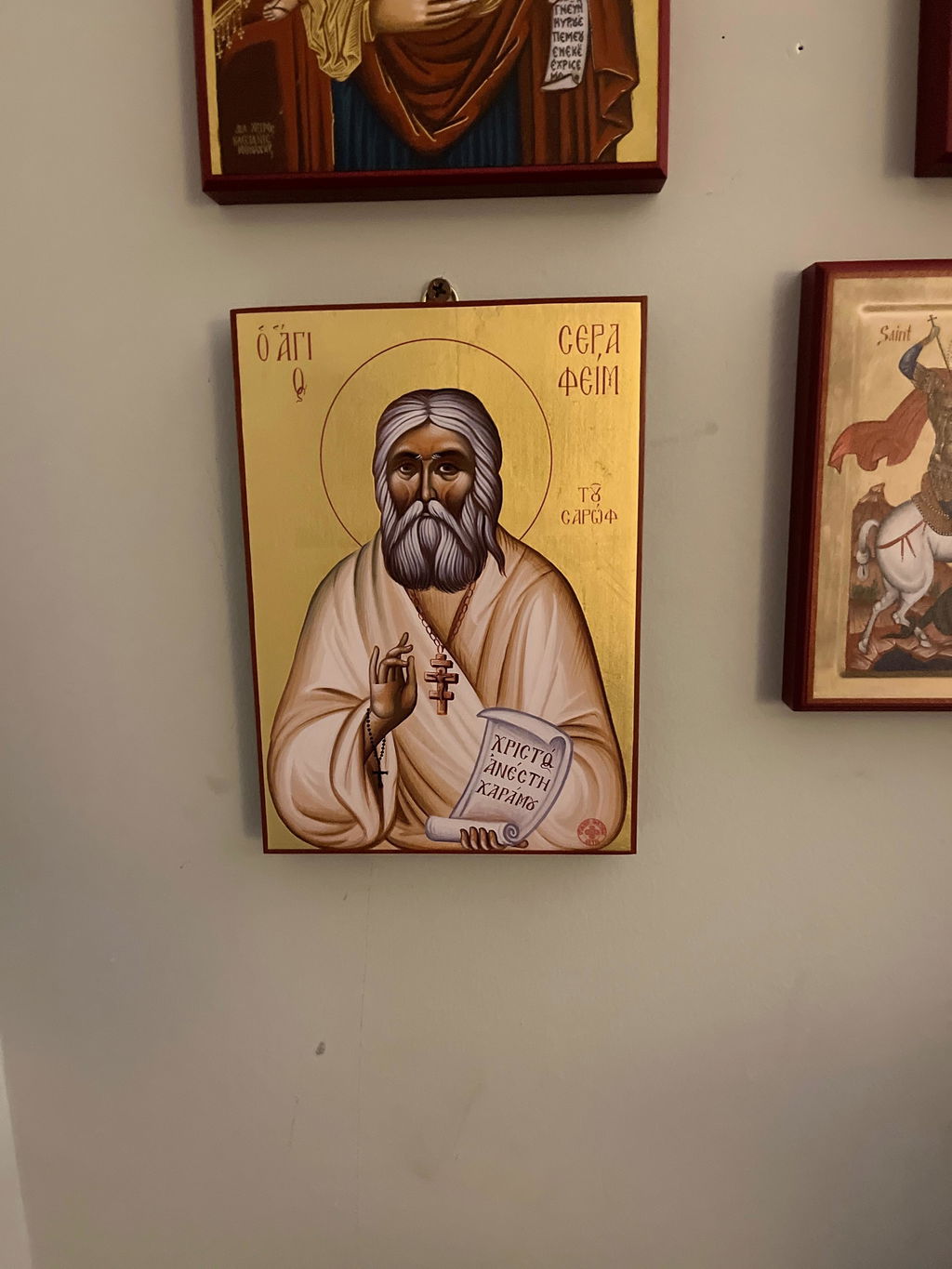
The Story Behind This Icon:
Saint Seraphim was born in 1759 in eastern Russia where he was heavily involved in the Orthodox Faith from a young age. When the Saint was nine years old, the most holy Mother of God appeared to him in a vision, and through her icon of Kursk, healed him from a grave sickness from which he had not been expected to recover. He entered the monastery of Sarov at the age of nineteen and was tonsured a monk at the age of twenty-six. During his time there, he grew closer to God and the Saints, again experiencing miracles and visions. Once, during the Divine Liturgy of Holy and Great Thursday, he was counted worthy of a vision of the Lord Jesus Christ, Who appeared encompassed by the heavenly hosts. After this dread vision, he gave himself over to greater labors.
After almost ten years at the monastery, he took up an isolated life in the forest. It was at this time that he took upon himself one of the greatest feats of his life. Assailed with despondency and a storm of contrary thoughts raised by the enemy of our salvation, the Saint passed a thousand nights on a rock, continuing in prayer until God gave him complete victory over the enemy. He finally returned to the monastery and lived there in peace, seeing and performing miracles for many. He fell asleep in 1833, having been visited by the Theotokos twelve times in his life. The last was on the Feast of the Annunciation, 1831, to announce to him that he would soon enter into his rest. She appeared to him accompanied by twelve virgin-martyrs and monastic saints, as well as Saint John the Baptist and Saint John the Theologian. With a body ailing and broken from innumerable hardships, and an unspotted soul shining with the light of Heaven, the Saint lived less than two years after this, falling asleep in peace on January 2, 1833, chanting Paschal hymns.
"Having left the beauty of the world and what is corrupt therein, O Saint, thou didst settle in the Monastery of Sarov. And having lived there an angelic life, thou wast for many the way unto salvation. Wherefore, Christ hath glorified thee, O Father Seraphim, and hath enriched thee with the gift of healing and miracles. And so we cry to thee: Rejoice, O Seraphim, our holy Father." -Kontakion of Saint Seraphim of Sarov
Saint Seraphim's feast day is celebrated on January 2.
***
This icon is made of solid, natural limewood (Tilia) that has been prepared by hand using traditional methods and organic materials. The background is comprised of 22 Karat gold leaves that were meticulously applied by hand, piece by piece.
All of our icons are reproduced according to museum print standards and are authentic replicas of Holy Icons from Mount Athos and elsewhere.
Learn more about how our Holy Icons are made here.